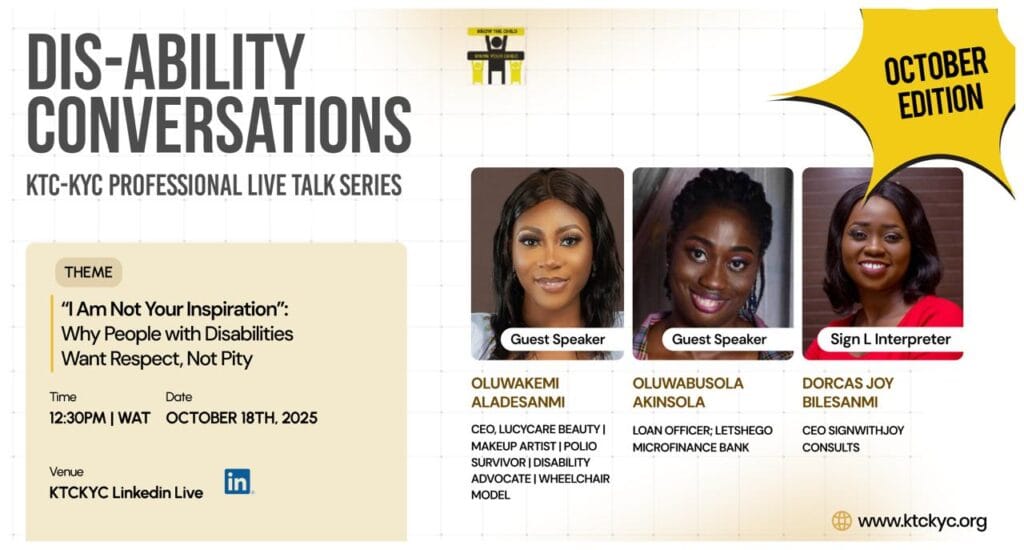
Dis-Ability Conversations – October Edition
October’s Dis-Ability Conversations took us into one of the most sensitive and often misunderstood aspects of disability: the thin line between admiration and pity.
We live in a world where it’s easy for people to confuse the two , where a simple “Wow, you’re so inspiring” can sometimes reveal more about society’s biases than about genuine respect.
When ‘Admiration’ Becomes an Insult
Ms. Oluwakemi shared how often people respond to her achievements with a mixed expression , admiration wrapped in pity.
Not because she isn’t capable, but because people struggle to separate disability from ability.
She described how embarrassing it can be when people downplay her competence, even unintentionally. The intention might be concern or praise, but the delivery is often rooted in pity.
Family: The First Agents of Mindset Reformation
One recurring lesson across all our editions is this: family plays a defining role in shaping how society views their loved ones with disabilities.
Ms. Kemi shared how her family constantly affirmed her personhood , reminding relatives and communities that she is a whole person, not “half” because of her disability.
This steady affirmation helped her build strong self-esteem, and it shows how important it is for families to use empowering language from the very start.
Words Matter, A Lot
Language has power.
Words like “deaf”, “crippled”, “disabled person”, or other labels can be reductionist and condescending when used casually or carelessly.
Our speakers emphasized using person-first language , “a person who is…” instead of defining someone by their condition.
“What Do You Mean, Can I Do the Job?”
Ms. Oluwabusola, a young adult living with cerebral palsy, shared a striking moment during her job search.
After successfully passing a bank’s interview stage, an interviewer asked if she could “really do the job.”
Her response was powerful:
“What do you mean, can I do the job? I went to Babcock University, earned a master’s in International Economics and Trade , and you think I can’t do the job?”
Her story reminded us that discrimination isn’t always loud. Sometimes it’s hidden inside assumptions.
Self-Advocacy: The Power of Your Own Voice
Our speakers reminded us that persons with disabilities must also be their own first advocates.
Telling your story from a place of strength, not apology, challenges society’s perceptions and forces people to rethink their biases.
We Can Celebrate Without Diminishing
One important takeaway:
We can applaud people’s achievements without making their disability the headline.
Success is success, full stop.
Final Thoughts
The October conversation closed with strong, unapologetic truths:
- “I am not your inspiration. I don’t need your pity.”
- “I am a person, not a disabled.”
- “Give empathy, not pity.”
- “Make the environment accessible. That’s what many people need.”
See the person.
See the strength.
See the ability.
And most importantly, let’s build a world where respect replaces pity, and inclusion replaces assumptions.
Raheem Amdalat Dolapo
For,
KTCKYC Educational Consult and Academy Ltd.
