
When conversations about disability come up, the focus often goes straight to the individual. But in reality, the journey begins long before society steps in, it starts within the family. And for many African families, that journey is often shaped by culture, silence, shame, and eventually, acceptance.
During our November edition of Dis-Ability Conversations, we explored the topic:
“Disability and the African Family: Culture, Shame & Acceptance.”
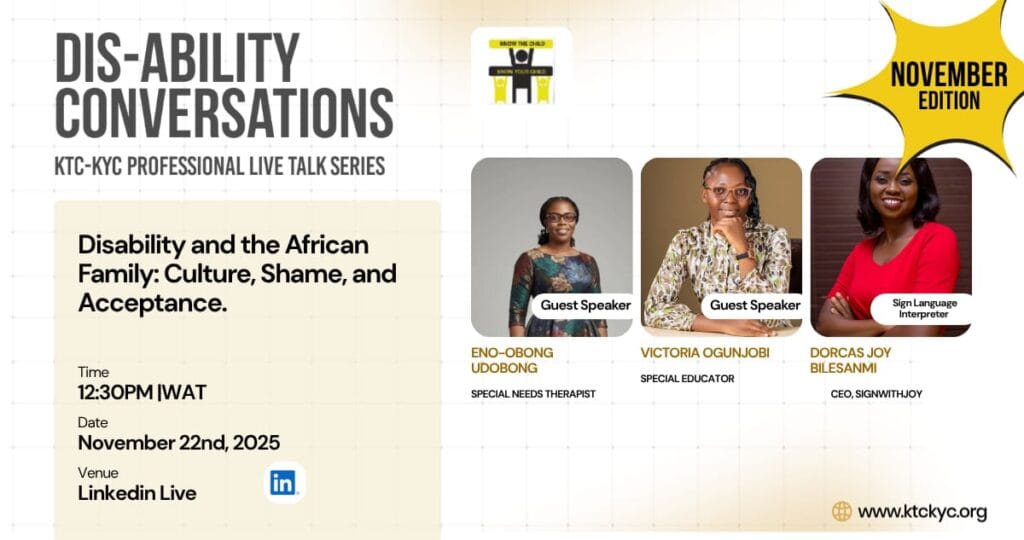
The discussion was honest, emotional, and deeply necessary.
Here are the reflections that stood out.
1. Acceptance Doesn’t Happen Overnight
One question guided the conversation: How does a parent move from denial to acceptance?
The answer; slowly, and with awareness.
Parents first have to acknowledge the reality of their child’s condition. Not as a punishment, not as something spiritual, and not as a failure. But simply as what it is.
Acceptance is a journey with no fixed timeline. What matters most is that, along the way, parents keep showing up for their child.
2. The Root of Shame: Culture’s Heavy Hand
Many African families still raise children under the weight of long-standing cultural beliefs. Disabilities have been labeled, misunderstood, and feared. Parents often hide their children because:
- “People will talk.”
- “This is a family disgrace.”
- “There is no support anywhere.”
- “They will deny the child opportunities.”
This silence has pushed many families into shame rather than support. But culture can evolve, and that evolution starts with awareness and openness.
3. The Rise of Inclusion: People Are Beginning to Speak Up
Thankfully, a new wave of advocacy is growing. More families are talking, more young people are speaking for themselves, and organizations are pushing for visibility.
Inclusion is no longer just a policy word. It’s becoming a practice.
But true inclusion requires more than just writing it down in a document. It must show up in:
- classrooms
- workplaces
- healthcare systems
- community structures
- family attitudes
When inclusion becomes a lived experience, shame begins to disappear.
4. Schools Must Do More Than Enroll — They Must Support
Creating an inclusive school environment goes beyond having a child with disability in the classroom. It involves:
- teachers trained to understand and support
- peers educated on empathy and acceptance
- systems designed to accommodate different learning needs
Inclusive education succeeds when everyone in the space is informed, compassionate, and ready to embrace differences.
5. Parents Need Therapy Too
One powerful reminder from the session:
It’s okay for a parent to be in denial — what is not okay is staying in denial.
Therapy helps parents understand the dangers of denial, the importance of acceptance, and how to provide the emotional stability their child needs.
Involving the child in this process also builds confidence and strengthens the parent-child relationship.
6. Awareness Leads to Acceptance and Acceptance Leads to Empowerment
We must lend our voices. We must speak about disability the same way we speak about every other part of life. When conversations grow, stigma shrinks.
Every child has a unique ability. When parents see and accept their child fully, it becomes easier to discover that strength, nurture it, and advocate confidently.
Because truly — if the family does not advocate for the child, who else will?
Final Thoughts
- Disability is not a disgrace.
- It is not a curse.
- It is not a family failure.
- It is a human experience.
- Acceptance is an act of love.
- Advocacy is an act of courage.
Awareness is an act of healing.
- Advocacy is an act of courage.
When families shift from shame to acceptance, society has no choice but to follow.
Thank you for being on this journey with us.
Would love to watch the session? Catch the replay HERE.
Warm regards,
The Dis-Ability Conversations Team
KTC-KYC Educational Consult & Academy Ltd.